

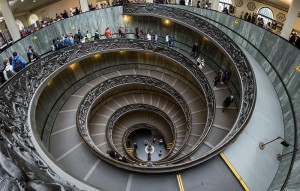
Last Thursday, March 26, 2015, the Vatican organized an exclusive tour of the Vatican museums for 150 homeless people in Rome. During the tour, the Pope himself welcomed the guests, telling them, “This is everyone’s house and your house. The doors are always open for all.”
Catholic News Services interviewed one of the guests, an Italian-speaking man named Mauro, about the experience:
Mauro, who speaks Italian and serves a spokesman for a group of Poles who sleep near the Vatican press office, told Catholic News Service March 27 that his favorite part of the Vatican Museums was the vintage carriage and car collection.
“I’m passionate about cars and what they have is great,” he said. “I had my picture taken there.”
Mauro said he and his friends always see long lines of tourists waiting to get into the museums, so it was great to see what all the fuss was about. And they didn’t even have to wait in line or deal with a crowd; “it was just us,” he said.
“It’s spectacular,” he said. “It’s beautiful.”
Taking the homeless on an exclusive tour of the Vatican museums is not the first idea thought of as a way to help them. In fact, the Church’s critics occasionally challenge her to sell all her cultural and artistic treasures and sell the proceeds to the poor to prove that she cares about them.
This line of thinking suffers one flaw, among many others: it forgets that the Church holds these treasures not for herself, but in trust for the rest of humanity including the poor. It forgets that the poor themselves would be even more impoverished if the Church would lose these treasures.
The poor crave not only for food, shelter, clothing, and medical care. The worst effect of poverty is not hunger, homelessness, or disease; it is the sense of being excluded from the human race. The poor long to be part of humanity, to partake of knowledge, culture, and beauty. They are not just animals to be kept healthy. They are persons capable of appreciating Michelangelo’s frescoes and who have unique interests like vintage carriages and cars.
It would be absurd to expect a dose of high culture to stave off the poor’s hunger pangs. Of course, their bodily needs should not be ignored. (In fact, dinner was served to the homeless guests of the Vatican museums after the tour.) However, the tendency to the opposite extreme must also be avoided, that of forgetting that they do not live on bread alone.
We often ask ourselves what can we share with the poor if we do not have much money. Learning, access to culture, enough cash for a ticket, a bit of time perhaps to read to a sick person or to accompany someone to a museum or a nice movie – these too can be shared. By reminding the poor (and ourselves) that they, too, own the treasures of all humanity, we remind them and ourselves that they, too, are part of the human race and are therefore also children of God.



2 thoughts on “Sharing the Treasures of Humanity with the Poor”
Pingback: EASTER MONDAY EXTRA - BigPulpit.com
The trouble with capitalism is it panders to wealth. The trouble with communism is
it kills the spirit The trouble with socialism is that it wastes wealth on those who use
its propensity to allow people to sit idle and not work while not creating jobs that promote growth. If we could take the demands of communism that requires one to do something for the common good and blend it with capitalism’s dynamic ability to innovate and expand ideas there would be work for all and unlimited opportunities
to better oneself at the expense of no one. Some day we will figure it out.