“I want atheism to be true and am made uneasy by the fact that some of the most intelligent and well-informed people I know are religious believers. It isn’t just that I don’t believe in God and, naturally, hope that I’m right in my belief. It’s that I hope there is no God! I don’t want there to be a God; I don’t want the universe to be like that.” (Thomas Nagel, The Last Word)
Some weeks I’m really not into writing long introductions to my pieces, so let’s get to it shall we: if God does not exist, then what follows is not that Hell does not exist, but rather that we already live there. Sure, we may not be shivering away in the ninth circle of Hell–though I suppose if we were, somebody would find a way to pin it on climate change–while having the endure the torment of Lucifer gnawing the flesh off of Judas and sucking the blood from Brutus [1]. Nevertheless, the idea of merely being in the first circle of Hell is not exactly my idea of warmth and comfort.
Usually people don’t necessarily associate the lack of God as being “Hell” at any level, other than to note in passing that suffering does exist here as it must surely exist in Hell (albeit perhaps to a lesser degree). However, the first and greatest torment of Hell is precisely this loss of the beatific vision, this absence of God. Here is Dante’s own description of the first circle of Hell–the “limbo” in which we find ourselves if there is no God:
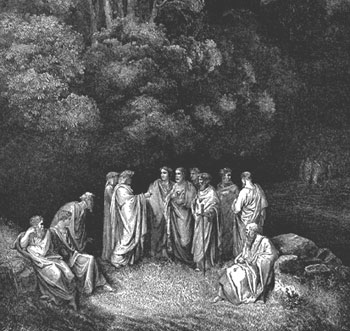
Dante and Virgil meet the virtuous damned in limbo. Art by Gustave Dore.
“In truth I found myself upon the brink
of an abyss, the melancholy valley
containing thundering, unending wailings….
Here, for as much as hearing could discover,
there was no outcry louder than the sighs
that caused the everlasting air to tremble.
The sighs arose from sorrow without torments,
out of the crowds–the many multitudes–
of infants and of women and of men.
The kindly master said: ‘Do you not ask
who are these spirits whom you see before you?
I’d have you know, before you go ahead,
they did not sin; and yet, though they have merits,
that’s not enough, because they lacked baptism,
the portal of the faith you embrace.
And if they lived before Christianity,
they did not worship God in fitting ways;
and of such spirits I myself am one.
For these defects, and for no other evil,
we now are lost and punished with just this:
we have no hope and yet we live in longing’ ”
(Inferno, Canto IV, 7-9, 25-42; transl. Allen Mandelbaum).
Sorrow without torment, living for ever with longing but no hope of satisfaction–this is the punishment of the damned in the first circle of Hell, which Dante equates to Limbo. For those in this circle, there is no further punishment than deprivation of God. The must live forever in longing for Him, and never have that longing satisfied–and they know that this longing will never be satisfied, so they cannot embrace even the hope that it will be. This is precisely where we find ourselves if there is no God, particularly if we know this to be true.
Could we be happy without God? The atheist often answers this with a yes. Try telling him that we all have a hole in our hearts which can only be filled with God, and he will more often than not scoff and laugh. There are plenty of other things which can make us happy, are there not? ‘Pursue pleasure or health and wealth or honor or even virtue instead,’ he might advise. Indeed, these things are all goods–they are each good to have and bad to lose (involuntarily), are they not?–so they can contribute to a life of satisfaction and contentment, at the very least. After all, happiness means obtaining or procuring what is good, does it not? I’m not aware of anyone who would deny this point; rather, most disagreements concern what is good, and how good it is. Thus, for example, if virtue is a greater good than pleasure, then it follows that we can gain greater happiness from being virtuous than from pursuing pleasure–and we will suffer a greater sorrow (or lack or loss of happiness) if we are not virtuous than if we fail to get much pleasure from life. But what is the highest good that a man can pursue?
Knowledge, love, virtue, health, pleasure, wealth, honor–these are all amongst the answers which are given to this question. Certainly, it could be argued in an Aristotelian manner that the highest goods of men is to know and to love [2], because these are the two things which we are uniquely capable of doing as men. Thus, the highest human (or natural) happiness comes from knowing and loving. There is, however, a greater good than either knowing or loving: God. Whatever its merits may be as an apologetic argument, Saint Anselm’s ontological proof reminds us of an important fact: God Is, by definition, that than which greater cannot be thought. Exist or not, God Is the greatest Being or thing which can exist even in principle.
And this means that God is the greatest good which we can somehow enjoy–in this case, via the beatific vision, via eternal communion with Him in heaven. Thus, while our greatest human happiness lies in knowing and loving, our greatest possible happiness lies in God. Our greatest possible sorrow therefore lies in losing the greatest possible happiness–sorrow is, after all, the negation of happiness, is it not?–so that our greatest possible sorrow comes from not obtaining union with God and knowing that we will not obtain that union. The other torments of Hell–from the fires traditionally envisioned to the frigid frosts of Dante’s ninth circle–are just the icing next to this one [3]. Whatever other goods we may find in this life, and whatever happiness those goods may bring us, are fleeting by comparison; they are feeble substitutions which we might have enjoyed all the more in God’s presence, but which become ultimately a hollow happiness in His absence.
God’s absence means Hell. If God does not exist, then He is essentially absent, which means that this life is already Hell. I suspect that the greatest difference between the Hell of this life without God, and the Hell of eternal life without God, is that on the one hand this life is not eternal, meaning that there can be no absolute certainty that God does not exist, and on the other that we can in this life attempt to put on a brave face by seeking happiness in other things. We may perhaps convince ourselves that we have succeeded in finding happiness: by burying ourselves in our work for the sake of money or honors or even simple knowledge; or by numbing the sorrow of despair with endless pleasures; or by attempting to love someone or something as best we are humanly able [4]. Absent God, we are ultimately faced with the realization that our happiness in this life must come to an end: meaning, in other words, that we must experience some sorrow for even our best efforts.
Even if we find other goods to pursue, ultimate happiness will not be ours. We can long for it, but if God does not exist, then we cannot gain the greatest possible good, and hence the greatest possible happiness. We must therefore endure the greatest possible sorrow, which is the knowledge that ultimate happiness can never be ours. The best reason to believe something is because it’s true. Thus, the best reason to believe in God is because He really does exist; but I think that the second-best reason to believe in God is because if we don’t, then Hell begins with life and, if we’re right or lucky, ends with death [5]. The second best reason to believe in God is for the sake of our own happiness and the happiness of the people we love; or at the very least, for the sake of not living in Hell.
—-Footnotes—-
[1] Artistic reasons aside, I often wonder if Dante did not mentally include as one of Hell’s tortures the psychological torture of having to watch the devil continually chewing on Judas, Brutus, and Cassius as the punishment for failed traitors to their lords. The constant thought, aside from “I thought it would be hot here” and “Does this mean that I’m not going to have a happy ending?,” would be “As soon as one of those mouths finishes, I could be next!” Not a pleasant thought to have for all of eternity.
[3] Which is not necessarily to discount these other torments as trivial, though they are all lesser torments by comparison. This sorrow is called “Poena Damni” (see the Catholic Encyclopedia’s entry for Hell). The Catechism of the Catholic Church tells us that “Hell’s principal punishment consists of eternal separation from God in whom alone man can have the life and happiness for which he was created and for which he longs.” (CCC 1057).
[4] Of course, as I have argued elsewhere, to love someone means to desire the greatest good for that person (a point which comes to me through Blessed Pope John Paul the Great). But the greatest possible good is God, so even the act of truly loving a person must mean desiring God for that person, even if He does not exist. A convinced atheist must, if he is consistent, desire that God exists even while being convinced that He doesn’t, and must desire this for the sake of His beloved. They seldom do, however.
[5] After which point, we cease to exist. On the other hand, if we’re wrong or unlucky, then Hell not only continues after death, but actually worsens because there will be an element of absolute certainty: God does exist, and we have rejected Him, and thus have forfeited the Ultimate Good forever.
—-Addendum—-
A lot of people are misunderstanding this post. This is not an argument which seeks to prove that God exists. It is an argument which says that if we cannot absolutely prove either way that God exists, then we must turn to the question of how we should live. Alternatively, it turns to the question of what we ought to desire. Should we desire that that than which greater cannot be thought does exist? Yes. Does this prove that God exists? No, and I never claimed that it did. Rather, my point is that God’s existence is something which should be desired.
Here is another way of putting it. The best reason to believe in something is because it is true–which I stated in my post. Arguments which seek to demonstrate or prove that God exists are thus arguments about the truth of God’s existence. There is more than one such argument, whatever may be those arguments’ merits or demerits. These would all be classed under “my best reason to believe in God.” The next best reason to believe something is because it is good. This is more a reason to desire that a thing be true, and (in the absence of evidence either way) to order your life in the hope that it might be true. For what it’s worth, the third best reason to believe something is because it is beautiful. Note well that the second best reason is subordinate to the best, and the third best to the second best. This means that if God does not exist and we know that God does not exist without a shadow of doubt (a thing which even some atheists do not claim), then the fact that God is good does not make Him exist. I never claimed that it did, contra some commentators.
JC is a cradle Catholic, and somewhat of a traditionalist conservative. He earned his Ph.D. in physics from the University of Texas at Austin in the summer of 2014. He is currently a tenure-track assistant professor of physics at a university in the deep south. He is a lay member of the Order of Preachers. JC has been happily married since June of 2010. He and his lovely wife have had two children born into their family, one daughter and one son; they hope to have a few more. He has at times questioned – and more often still been questioned about – his Faith, but he has never wandered far from the Church, nor from our Lord. “To whom else would I go?”
Leave a Replay
9 thoughts on “My Second Best Reason to Believe in God”
Robert Gotcher
C.S. Lewis reflects upon this at length in Perelandra.
Just because it might be unfavorable to imagine life without God is not a reason to believe in God, nor does it count as evidence for God. By admitting this is a reason you’re showing that you’re willing to delude yourself into believing in a God regardless of whether there is one or not. And that’s remarkable.
I can think of a number of things that if they were true, would make life on Earth happier and better. But I don’t believe in those things because there’s absolutely no logic or evidence behind fairy tales.
Zach,
I’m not thinking that you understood his argument very well. It seems to me that JC is using a variation of Pascal’s wager. That argument assumes that you are unable to decide based on evidence evidence alone.
Combining Anselm (who begs the question) with a definition of hell simply produces a horde of question-begging street urchins.
“Einst warf auch Zarathustra seinen Wahn jenseits des Menschen, gleich allen Hinterweltlern. Eines leidenden und zerqualten Gottes Werk schien mir da die Welt. Traum schien mir da die Welt, und dichtung eines Gottes; farbiger Rauch vor den Augen eines gottlich Unzufriednen. Gut und bose un Lust und Leid un Ich und Du — farbiger Rauch dunkte mich’s vor schopferischen Augen, Wegsehn wollte der Schopfer von sich — da schuf die Welt..”
Alternatively, see Kierkegaard’s Philosophical Crumbs, [245-250].
@Robert: yes, that’s true. It’s been a few years since I last read Lewis’ trilogy. Ira Nee is correct that I was thinking a bit about Pascal’s Wager, but it wasn’t really at the forefront of my mind while I was writing this.
@Nathanael (Blake? is that you?): Using a definition is not the same thing as question-begging. I pointed to St Anselm only to note in passing that I am using his definition of God–that than which greater cannot be thought–not necessarily his argument. Concerning that argument, I happen to Agree with Dr Edward Feser’s brief assessment that there are three basic (educated) responses to St Anselm, which depend on which of two philosophies (modern or classical) a person approaches it from: “This is obviously stupid, but where exactly is the mistake?” (modern philosophy, a summary incidentally of Bertrand Russell’s assessment), “This seems plausible on the surface, but there must be a mistake somewhere” (which seems to be the assessment of Feser himself), or “This is obviously right.” Recall that I stated already that the best reason to believe something is because it’s true, meaning that this second-best reason works when there is epistemological uncertainty: which is also true of Pascal’s wager, FWIW. In the case of a person who already knows that God exists, it is reinforcement but also a sort of call to act on that knowledge; in the case of a person who is convinced that God does not exist, this argument at best shows that what is good is opposed to what the person believes is true.
@Zach–Although Pascal was and I am a Catholic, this argument does not necessarily lead to Catholicism. I never claimed it did. Neither does Pascal, beyond that it is a call to start living as if God does exist, and that ultimately requires making a choice of gods or God. I believe that there are very good arguments which lead to Christianity (and from there to specifically Catholicism), especially after God is established as true (or at the least as the best belief in absence of epistemological certainty either way). However, the comments section of a blog post is the best forum for those arguments (especially since for whatever reason the comments on this blog get turned off after a couple of weeks).
@Zach I agree that feeling the “need” for God is certainly not a sound position to try and give evidence of His existence. I think at that point it becomes much more about “us” and not about God being His absolute, immutable “Self.” However I will say this — if there is indeed a God and our existence is entirely contingent and derivative of Him, then we inherently would “need” Him. As a creature, we are in debt to the Creator. The fact that we feel a yearning for deeper transcendence should never be negatively viewed as a “crutch” or an “escapist” fantasy to avoid the impersonal forces of nature. Those pessimistic views assume the non-existence of God from the get-go.
What fairy tales? On what basis do you say, “there’s absolutely no logic or evidence behind fairy tales”? If you assume (or assert) this, then call a description of reality a “fairy tale” is to beg the question in a very big way. “Its not true because it is a fairy tale and fairy tales are always not true in any sense of the word.”



9 thoughts on “My Second Best Reason to Believe in God”
C.S. Lewis reflects upon this at length in Perelandra.
Just because it might be unfavorable to imagine life without God is not a reason to believe in God, nor does it count as evidence for God. By admitting this is a reason you’re showing that you’re willing to delude yourself into believing in a God regardless of whether there is one or not. And that’s remarkable.
I can think of a number of things that if they were true, would make life on Earth happier and better. But I don’t believe in those things because there’s absolutely no logic or evidence behind fairy tales.
Zach,
I’m not thinking that you understood his argument very well. It seems to me that JC is using a variation of Pascal’s wager. That argument assumes that you are unable to decide based on evidence evidence alone.
I’d hate to see your third best…
Combining Anselm (who begs the question) with a definition of hell simply produces a horde of question-begging street urchins.
“Einst warf auch Zarathustra seinen Wahn jenseits des Menschen, gleich allen Hinterweltlern. Eines leidenden und zerqualten Gottes Werk schien mir da die Welt. Traum schien mir da die Welt, und dichtung eines Gottes; farbiger Rauch vor den Augen eines gottlich Unzufriednen. Gut und bose un Lust und Leid un Ich und Du — farbiger Rauch dunkte mich’s vor schopferischen Augen, Wegsehn wollte der Schopfer von sich — da schuf die Welt..”
Alternatively, see Kierkegaard’s Philosophical Crumbs, [245-250].
Then why does he wager against every other faith available on earth?
@Robert: yes, that’s true. It’s been a few years since I last read Lewis’ trilogy. Ira Nee is correct that I was thinking a bit about Pascal’s Wager, but it wasn’t really at the forefront of my mind while I was writing this.
@Nathanael (Blake? is that you?): Using a definition is not the same thing as question-begging. I pointed to St Anselm only to note in passing that I am using his definition of God–that than which greater cannot be thought–not necessarily his argument. Concerning that argument, I happen to Agree with Dr Edward Feser’s brief assessment that there are three basic (educated) responses to St Anselm, which depend on which of two philosophies (modern or classical) a person approaches it from: “This is obviously stupid, but where exactly is the mistake?” (modern philosophy, a summary incidentally of Bertrand Russell’s assessment), “This seems plausible on the surface, but there must be a mistake somewhere” (which seems to be the assessment of Feser himself), or “This is obviously right.” Recall that I stated already that the best reason to believe something is because it’s true, meaning that this second-best reason works when there is epistemological uncertainty: which is also true of Pascal’s wager, FWIW. In the case of a person who already knows that God exists, it is reinforcement but also a sort of call to act on that knowledge; in the case of a person who is convinced that God does not exist, this argument at best shows that what is good is opposed to what the person believes is true.
@Zach–Although Pascal was and I am a Catholic, this argument does not necessarily lead to Catholicism. I never claimed it did. Neither does Pascal, beyond that it is a call to start living as if God does exist, and that ultimately requires making a choice of gods or God. I believe that there are very good arguments which lead to Christianity (and from there to specifically Catholicism), especially after God is established as true (or at the least as the best belief in absence of epistemological certainty either way). However, the comments section of a blog post is the best forum for those arguments (especially since for whatever reason the comments on this blog get turned off after a couple of weeks).
@Zach I agree that feeling the “need” for God is certainly not a sound position to try and give evidence of His existence. I think at that point it becomes much more about “us” and not about God being His absolute, immutable “Self.” However I will say this — if there is indeed a God and our existence is entirely contingent and derivative of Him, then we inherently would “need” Him. As a creature, we are in debt to the Creator. The fact that we feel a yearning for deeper transcendence should never be negatively viewed as a “crutch” or an “escapist” fantasy to avoid the impersonal forces of nature. Those pessimistic views assume the non-existence of God from the get-go.
1) God does not exist and is thus absent.
2) One form of christian mythology defines “hell” as “the absence of god”.
3) As we are living in a universe where god does not exist, we are essentially in hell.
4) Therefore god exists.
This is your second best reason? Maybe you should stick to one.
Zach,
What fairy tales? On what basis do you say, “there’s absolutely no logic or evidence behind fairy tales”? If you assume (or assert) this, then call a description of reality a “fairy tale” is to beg the question in a very big way. “Its not true because it is a fairy tale and fairy tales are always not true in any sense of the word.”